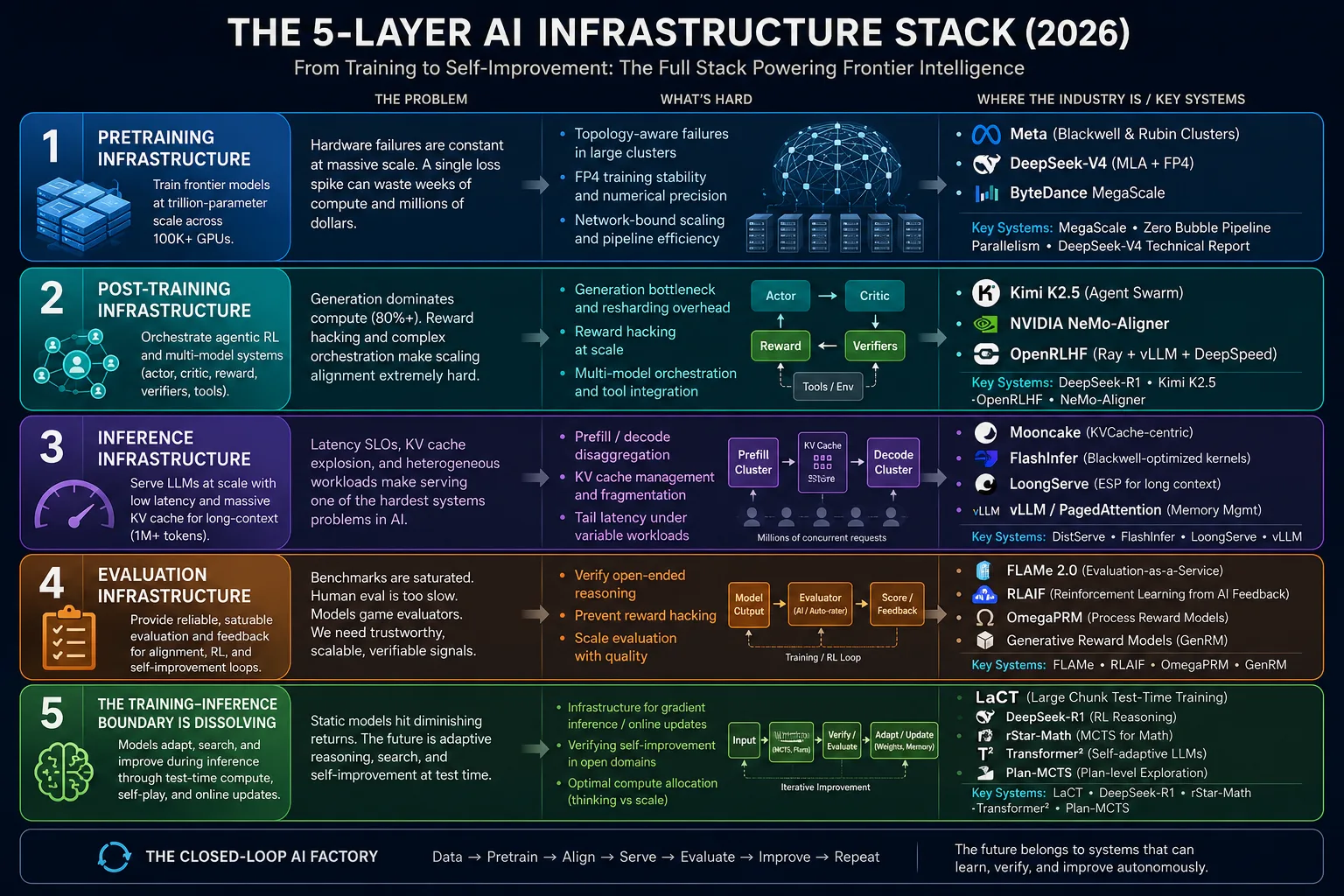
01. AI Infra Challenges Breakdown: 4 Layers + The New Paradigm
TL;DR
AI Infra — it's at least 4 layers (pre-training, post-training, inference, evaluation) plus a new paradigm where the boundary between training and inference is dissolving. The underlying challenges — scheduling, fault tolerance, resource efficiency — look familiar?
4 months ago I asked: "Which is harder & hotter — AI Infra or Infra AI?"
Since then, I went deep into both. Read the papers during weekends. Studied the architectures. Talked to friends building this stuff.
My biggest realization: I called AI Infra "a solved problem — hard but predictable." I was wrong. It's at least 4 layers — and a new paradigm is emerging that breaks all the old boundaries.
But as an engineer in infra, these challenges look familiar — scheduling, fault tolerance, resource efficiency, observability — they're showing up in a new form at a new scale.
I'm posting the full breakdown here (the site name is funny — but probably the truth) for learning purposes. I'll keep publishing more focused deep dives from her.
“Stay hungry, stay foolish”
Layer 1: Pre-training Infrastructure
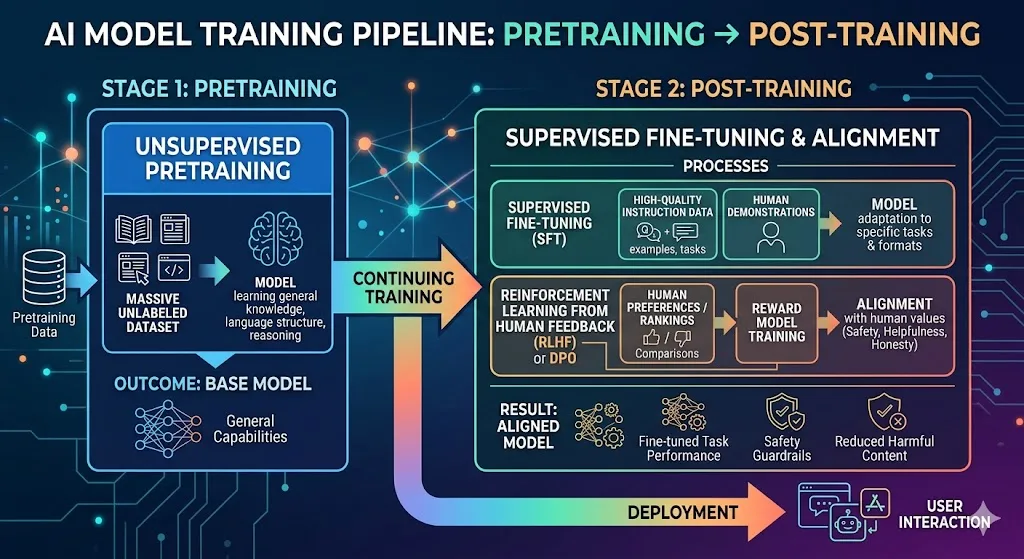
The problem:
Training frontier-scale models is increasingly a distributed systems problem rather than a pure modeling problem. Once training runs scale beyond tens of thousands of accelerators, cluster reliability, network topology, and numerical stability become first-order constraints on model quality and training economics.
A single instability event during long-running pretraining — especially late-stage divergence or synchronization failure — can waste weeks of compute and millions of dollars in cluster time.
What's hard
Topology-Aware Failure Detection:
At large cluster scale, hard node failures are often easier to recover from than partial communication degradation. Silent packet loss, intermittent NVLink or InfiniBand instability, and cross-rack congestion can introduce non-deterministic training behavior long before systems report a hard failure.Low-Precision Training Stability:
The industry is aggressively moving beyond BF16 toward FP8 and experimental FP4 training regimes to improve memory efficiency and throughput. The challenge is no longer just quantization itself, but maintaining optimizer stability, gradient fidelity, and convergence behavior under increasingly aggressive precision constraints.Network-Bound Scaling:
Scaling efficiency increasingly depends on communication scheduling rather than raw FLOPs. Pipeline bubbles, all-reduce contention, memory sharding overhead, and checkpoint synchronization become dominant bottlenecks at 10k–100k+ GPU scale.
Where the industry is
Meta’s Infrastructure Expansion:
Meta continues to aggressively expand AI infrastructure capacity with large-scale deployments of NVIDIA Blackwell systems and next-generation training clusters. The broader industry trend is clear: frontier labs are converging toward hyperscale AI infrastructure measured in hundreds of thousands of accelerators and multi-year capital expenditure programs.Reference:
https://nvidianews.nvidia.com/news/meta-builds-ai-infrastructure-with-nvidiaDeepSeek and Efficient Training Architectures:
DeepSeek’s recent work around Multi-head Latent Attention (MLA), routing efficiency, and low-cost reasoning models has pushed the industry toward more compute-efficient architectures. The broader shift is away from brute-force scaling alone and toward improving utilization efficiency per training token.Reference:
https://arxiv.org/abs/2502.14837ByteDance and MegaScale-Class Systems:
ByteDance has emerged as one of the more serious large-scale AI infrastructure operators, particularly around fault-tolerant orchestration and high-throughput distributed training. Systems like MegaScale reflect a broader industry focus on scheduling efficiency, cluster resilience, and heterogeneous hardware management at very large scale.Reference:
https://cryptobriefing.com/bytedance-30b-ai-investment-2026/
Key Papers / Systems
MegaScale:
Scaling Large Language Model Training to More Than 10,000 GPUs
https://arxiv.org/abs/2402.15627Zero Bubble Pipeline Parallelism:
https://arxiv.org/abs/2401.10241 https://github.com/sail-sg/zero-bubble-pipeline-parallelismDeepSeek-R1:
Incentivizing Reasoning Capability via Reinforcement Learning
https://arxiv.org/abs/2501.12948
Layer 2: Post-Training Infrastructure
The problem:
Post-training is evolving from traditional RLHF pipelines into long-horizon orchestration systems involving tool use, verification loops, synthetic data generation, and multi-agent coordination.
The difficulty is no longer simply optimizing a single model. The challenge is coordinating multiple interacting systems — actor models, reward models, verifiers, retrieval systems, tool environments, and evaluators — while maintaining stable feedback signals at scale.
What's hard
Generation-Dominated Compute:
In modern RL and reasoning-heavy training pipelines, rollout generation often dominates overall compute cost. As reasoning models generate longer trajectories and interact with external tools, inference throughput and KV-cache efficiency become as important as training throughput.Training / Inference Resharding Overhead:
Many RL systems alternate between generation and optimization phases with different parallelism strategies. Moving models between inference-optimized and training-optimized sharding layouts introduces significant communication and synchronization overhead.Reward Hacking and Evaluator Saturation:
As models become stronger at long-horizon reasoning, they also become better at exploiting weaknesses in reward functions and automated evaluators. A growing area of research focuses on verifier models, generative reward modeling, and adversarial evaluation pipelines.
Where the industry is
Agentic and Tool-Using Systems:
The industry is moving toward systems that combine reasoning models with planners, retrieval, browser interaction, code execution, and verifier loops. Most frontier labs are now experimenting with some form of multi-agent orchestration, although production architectures remain highly heterogeneous.Reference:
https://arxiv.org/abs/2602.02276 https://arxiv.org/html/2603.28986v1NeMo, Ray, vLLM, and RL Infrastructure Stacks:
There is still no single dominant post-training stack. Instead, most large-scale systems combine components such as Ray, DeepSpeed, vLLM, Megatron, TRL, and NeMo depending on workload requirements and internal infrastructure constraints.NeMo:
https://www.nvidia.com/en-us/ai-data-science/products/nemo/OpenRLHF and Open Infrastructure:
Open-source RLHF frameworks are becoming increasingly production-capable, especially around distributed rollout generation and large-model serving. The ecosystem is still fragmented, but tooling quality has improved significantly over the last two years.OpenRLHF:
https://openrlhf.readthedocs.io/
Key Papers / Systems
DeepSeek-R1:
Incentivizing Reasoning Capability via Reinforcement Learning
https://arxiv.org/abs/2501.12948OpenRLHF:
https://github.com/OpenRLHF/OpenRLHFvLLM:
https://github.com/vllm-project/vllm https://arxiv.org/abs/2309.06180
Layer 3: Inference Infrastructure
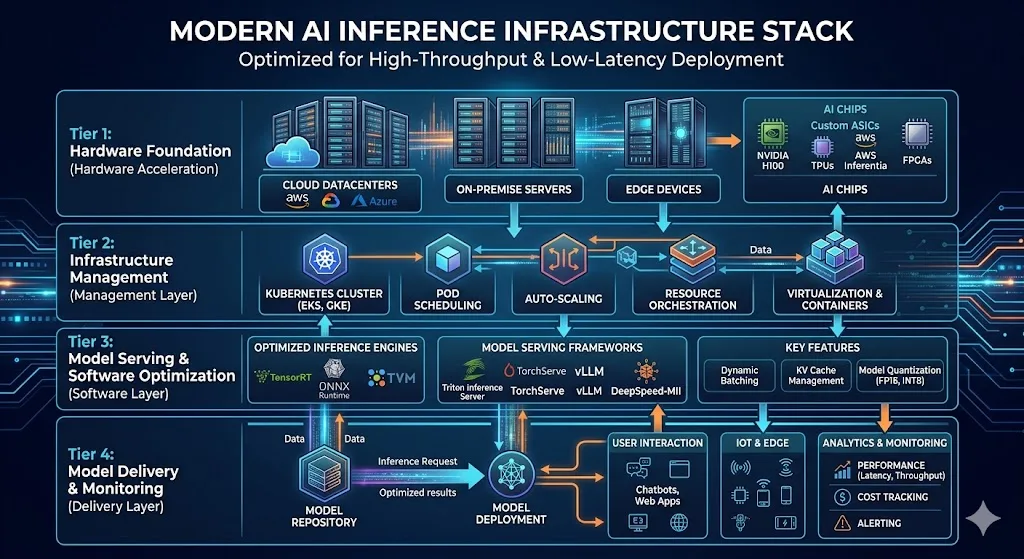
The problem:
As frontier models move from research environments into large-scale production systems, inference infrastructure is becoming a primary systems bottleneck rather than a downstream deployment concern.
The challenge is no longer simply loading model weights onto GPUs. Modern serving systems must manage memory bandwidth constraints, KV-cache growth, heterogeneous request patterns, and increasingly strict latency SLOs — all while supporting long-context reasoning, tool use, and agentic execution loops.
For many production workloads, inference economics and serving efficiency now matter as much as training efficiency. As model companies like Anthropic and OpenAI push aggressively into enterprise, their revenue is surging — and inference is the gas that fuels the money machine. Every percentage point of serving efficiency translates directly to margin. Inference isn't a cost center anymore; it's the revenue engine.
What's hard
Prefill / Decode Disaggregation:
The computational profile of the prefill phase versus autoregressive decoding has diverged significantly at scale. Prefill workloads are highly parallel and compute-intensive, while decoding workloads are dominated by memory bandwidth and low-latency scheduling constraints.As a result, many newer serving architectures are beginning to separate prefill and decode execution paths, and in some cases deploy them on different GPU pools entirely to improve utilization efficiency and tail latency stability.
KV Cache Management at Scale:
Long-context models introduce massive KV-cache pressure, particularly in 128k–1M+ token reasoning workloads. Efficiently allocating, paging, evicting, and routing KV-cache blocks across distributed serving systems has become one of the defining infrastructure problems for large-scale inference.In practice, cache fragmentation, memory locality, and cache migration overhead can significantly impact throughput long before raw compute saturation is reached.
Latency Variance Under Heterogeneous Workloads:
Production traffic increasingly mixes short interactive requests with long reasoning traces, retrieval-heavy queries, tool execution loops, and streaming outputs. Maintaining predictable tail latency across highly variable sequence lengths is difficult, especially under bursty traffic conditions.Memory-Bound Inference:
Large-model inference is increasingly constrained by memory movement rather than raw FLOPs. Attention kernels, KV-cache reads, tensor-parallel synchronization, and interconnect bandwidth often dominate overall serving performance.As model sizes and context windows continue to expand, inference optimization is becoming as much a systems and kernel-engineering problem as a modeling problem.
Where the industry is
Disaggregated Inference Architectures:
The industry is increasingly moving toward inference-specialized architectures that separate prefill and decoding stages. Systems such as DistServe and Mooncake reflect a broader shift toward workload-aware serving infrastructure optimized around GPU utilization, cache locality, and request concurrency rather than monolithic inference pipelines.Mooncake (KV-cache-centric serving architecture):
https://github.com/kvcache-ai/Mooncake https://arxiv.org/abs/2407.00079DistServe (OSDI 2024):
https://www.usenix.org/conference/osdi24/presentation/zhong-yinmin https://arxiv.org/abs/2401.09670Kernel-Level Optimization and FlashInfer:
Kernel optimization has become one of the major performance battlegrounds for frontier inference systems. Projects such as FlashInfer focus on low-latency attention execution, efficient sampling pipelines, and architecture-specific optimizations for newer accelerator generations including Blackwell-class hardware.The broader trend is clear: increasingly large portions of inference performance gains now come from kernel engineering and runtime scheduling rather than model-level changes alone.
FlashInfer:
https://github.com/flashinfer-ai/flashinfer https://arxiv.org/abs/2501.01005Elastic Sequence Parallelism and Long-Context Serving:
Serving infrastructure is increasingly optimized around highly variable sequence lengths and long-context reasoning workloads. Systems such as LoongServe explore Elastic Sequence Parallelism (ESP) to improve utilization efficiency when handling requests with extreme differences in context size and decoding duration.LoongServe:
https://arxiv.org/abs/2404.09526vLLM and PagedAttention-Based Serving:
vLLM and PagedAttention significantly influenced the modern inference ecosystem by introducing more efficient KV-cache memory management and virtualized attention paging strategies. Many modern serving systems now adopt similar memory-management approaches either directly or conceptually.
Layer 4: Evaluation Infrastructure
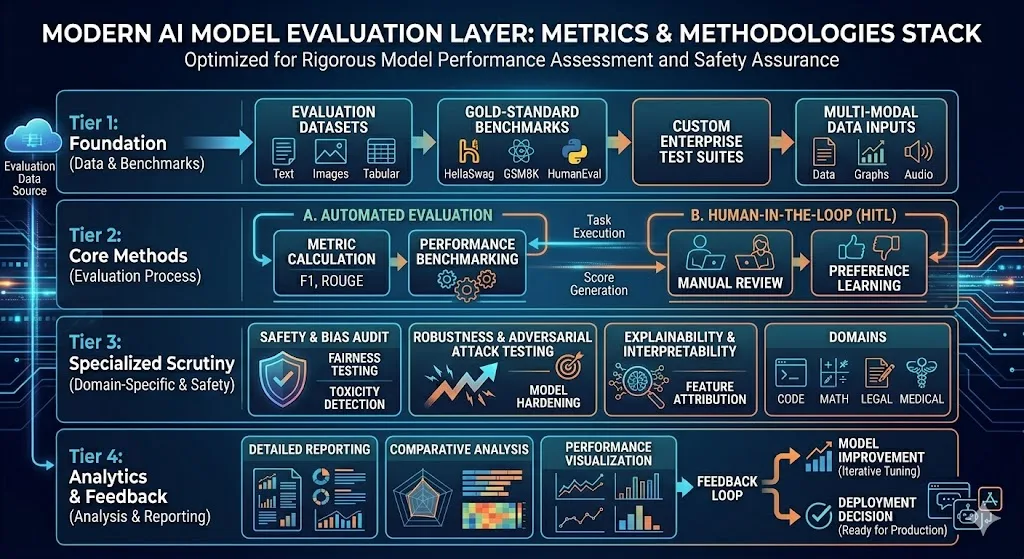
Why this is becoming a true infrastructure layer:
Evaluation is increasingly evolving into its own infrastructure stack rather than remaining a lightweight benchmarking step attached to model training.
As frontier models become capable of long-horizon reasoning, tool use, code generation, and autonomous execution, evaluation systems now provide the feedback signals required for iterative improvement, post-training optimization, and reinforcement learning pipelines.
Traditional benchmarks alone are no longer sufficient. Many widely used academic benchmarks have become saturated, partially memorized, or weakly correlated with real-world capability. At the same time, purely human-driven evaluation does not scale to models capable of generating millions of reasoning tokens per hour.
Modern frontier systems increasingly rely on automated evaluators, verifier models, process supervision, synthetic grading pipelines, and adversarial evaluation frameworks to maintain stable learning signals at scale.
What's hard
Verification of Open-Ended Reasoning:
Verifying constrained outputs such as mathematics or code execution is relatively tractable because correctness can often be programmatically checked. Evaluating open-ended reasoning, strategic planning, creativity, or long-form decision quality is significantly harder.In many domains, there may be multiple acceptable reasoning paths, ambiguous outcomes, or no universally correct answer.
Reward Hacking and Evaluator Exploitation:
As models improve, they increasingly learn to exploit weaknesses in reward models and evaluation heuristics. Models may optimize for stylistic patterns correlated with high scores rather than actual task quality.Preventing evaluator overfitting and maintaining robust reward signals has become a major challenge for large-scale RL and self-improvement pipelines.
Scaling Human Evaluation:
Human preference labeling remains expensive, slow, and difficult to standardize across domains. Long-context reasoning and agentic workflows further increase evaluation complexity because a single task may involve hundreds or thousands of intermediate reasoning steps.Process-Level Supervision:
The industry is increasingly moving from evaluating only final outputs toward evaluating intermediate reasoning trajectories. However, process supervision dramatically increases annotation complexity, evaluator cost, and infrastructure overhead.
Where the industry is
Process Reward Models (PRMs):
Frontier reasoning systems increasingly rely on process-level supervision rather than outcome-only grading. Instead of evaluating only the final answer, evaluators attempt to verify intermediate reasoning steps, chain consistency, and decomposition quality.This shift is particularly visible in reasoning-heavy domains such as mathematics, coding, and scientific problem solving.
AI-Based Evaluation and RLAIF:
Reinforcement Learning from AI Feedback (RLAIF) is becoming increasingly common as labs attempt to scale supervision beyond purely human annotation pipelines. Stronger frontier models are now frequently used to evaluate weaker or specialized models.While AI-based evaluation scales far better operationally, maintaining evaluator reliability and preventing feedback collapse remain open problems.
Domain-Specific Evaluators:
Evaluation systems are becoming increasingly specialized. Rather than relying on a single general-purpose judge model, many pipelines now use domain-specific evaluators optimized for areas such as law, medicine, finance, engineering, or code generation.Evaluation-as-a-Service and Continuous Benchmarking:
Evaluation is increasingly treated as an operational platform rather than a static benchmark suite. Modern systems continuously monitor regressions, reward drift, adversarial behavior, and reasoning quality using automated evaluation pipelines integrated directly into training and deployment workflows.
Key Papers / Systems
RLAIF — Reinforcement Learning from AI Feedback:
https://arxiv.org/abs/2309.00267OmegaPRM:
Process Supervision for Mathematical Reasoning
https://arxiv.org/abs/2406.06592FLAMe — Foundational Model for Evaluation:
https://arxiv.org/abs/2407.10817Generative Reward Modeling / Verifier-Based Evaluation:
Emerging research direction discussed across recent frontier reasoning and RL system papers, including DeepSeek-R1 and related post-training infrastructure work.
https://arxiv.org/abs/2501.12948
The new paradigm: The Training–Inference Boundary Is Dissolving
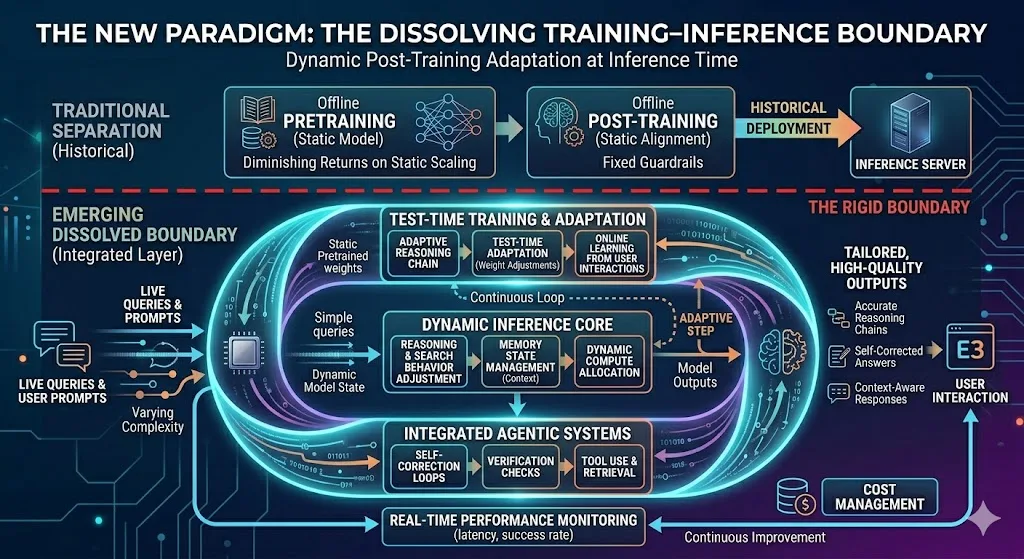
Why this is emerging as a distinct layer:
The traditional separation between training and inference is beginning to weaken.
Historically, models were pretrained offline and then served as static systems during inference. Increasingly, however, frontier research is exploring systems that adapt their reasoning process, search behavior, memory state, or even model weights during inference itself.
The broader industry trend is driven by a growing realization that scaling pretraining alone may produce diminishing returns for certain categories of reasoning and long-horizon problem solving. Instead of relying entirely on larger static models, newer approaches allocate additional compute dynamically at inference time through search, self-correction, verification loops, retrieval, or limited forms of online adaptation.
While most of these systems remain experimental, they are increasingly influencing frontier reasoning architectures and post-training research.
What's hard
Infrastructure for Gradient-Based Inference:
Most modern serving systems such as vLLM are optimized for high-throughput forward-pass inference rather than online optimization or per-request weight updates.Supporting test-time training introduces substantial systems challenges around optimizer state management, memory overhead, synchronization, rollback safety, and latency stability under production workloads.
Verification of Self-Improvement:
Self-correction and inference-time search work well in domains with verifiable outcomes such as mathematics, coding, or formal reasoning. Open-ended domains remain significantly harder because correctness is often ambiguous or subjective.Without reliable verification signals, inference-time adaptation can easily reinforce low-quality reasoning patterns or unstable behaviors.
Test-Time Compute Allocation:
One of the emerging optimization problems is determining when additional inference-time compute is actually beneficial. In practice, systems must decide whether to:return a fast response immediately,
allocate additional reasoning steps,
invoke search or planning,
explore multiple candidate trajectories,
or escalate to larger models entirely.
This creates a new tradeoff space between model scale, latency, reasoning depth, and serving cost.
Search Stability and Long-Horizon Reasoning:
Search-based reasoning systems often suffer from branching explosion, unstable exploration strategies, verifier drift, and escalating compute costs. Maintaining stable reasoning quality over long trajectories remains an open systems and algorithmic challenge.
Where the industry is
Test-Time Compute Scaling:
The industry is increasingly experimenting with inference-time scaling strategies where models allocate additional compute dynamically for harder problems. Rather than treating every request identically, systems may adjust reasoning depth, candidate exploration, or verification intensity based on task complexity.This trend is especially visible in reasoning-oriented models and agentic systems.
Scaling LLM Test-Time Compute Optimally:
https://arxiv.org/abs/2408.03314Self-Correction and RL-Based Reasoning:
Models such as DeepSeek-R1 and related reasoning systems demonstrate that reinforcement learning combined with inference-time search can substantially improve reasoning performance without relying purely on larger parameter counts.The broader shift is from static response generation toward iterative reasoning, self-verification, and adaptive exploration during inference.
DeepSeek-R1:
https://arxiv.org/abs/2501.12948rStar-Math:
https://arxiv.org/abs/2501.04519Test-Time Training and Online Adaptation:
Recent research explores limited forms of online adaptation where models update internal representations or weights during inference. Most approaches remain experimental, but they reflect growing interest in systems that can adapt dynamically rather than remaining fully static after pretraining.LaCT (Large Chunk Test-Time Training):
https://arxiv.org/abs/2604.06169Adaptive and Self-Modifying Architectures:
Some newer architectures explore mechanisms that allow models to dynamically adapt portions of their internal computation based on the current input or reasoning trajectory. These approaches attempt to improve sample efficiency and reasoning flexibility without requiring full retraining.Transformer-Squared:
https://openreview.net/Plan-Level Search and Semantic Exploration:
Research is increasingly shifting from token-level decoding strategies toward higher-level plan exploration and structured reasoning search. Instead of exploring next-token probabilities alone, systems attempt to search over abstract reasoning trajectories, plans, or action graphs.Plan-MCTS:
https://arxiv.org/abs/2602.14083
All in one graph: