
Agent Landscape #2: Orchestration — Pick Your Reasoning Loop
TL;DR
Pick LangGraph (34k stars) for complex branching logic, CrewAI (53k stars) for fast prototyping, PydanticAI (17k) for type-safe single-agent, AgentScope (26k) for batteries-included. Hermes (190k) and OpenClaw (378k) add self-improvement. Visual builders (n8n 192k, Langflow 150k, Dify 145k) are how most teams actually start. The real differentiation isn't the happy path — it's error recovery, loop control, and whether the agent gets better over time.
The Problem
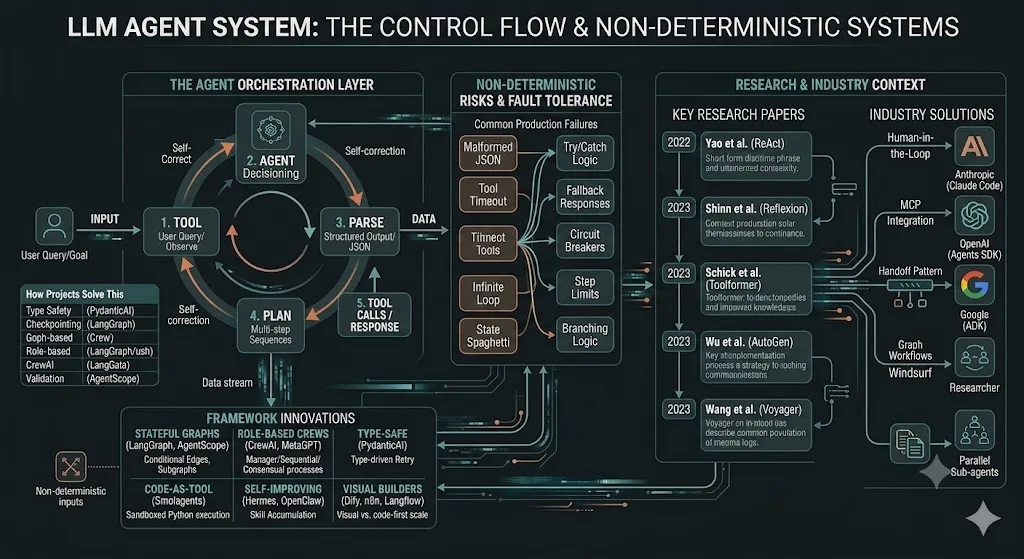
Your agent works perfectly in a demo: call a tool, get a result, respond. Then production happens:
The LLM returns malformed JSON for the tool call → crash
The tool times out → agent doesn't know whether it succeeded or failed
The LLM calls the same tool 50 times in a loop → infinite cost
You need two agents to collaborate → how do they share state?
The task requires 12 steps with branching logic → your
while Trueloop becomes spaghetti
The fundamental problem is control flow for non-deterministic systems. Traditional programming has if/else/try/catch. Agent orchestration needs the same — but the "program" is an LLM whose outputs are probabilistic, whose reasoning can loop, and whose tool calls have real-world side effects.
Research & Industry Context
Key Papers
ReAct (Yao et al., 2022) — established the think → act → observe pattern that almost every framework implements. Showed that interleaving reasoning traces with tool use outperforms either alone.
Reflexion (Shinn et al., 2023) — agents that reflect on failures and adjust strategy. Key insight: single-loop ReAct fails on complex tasks; adding a self-critique step dramatically improves multi-step success rates.
Toolformer (Schick et al., 2023) — LLMs that learn when and how to call tools. Demonstrated that tool selection is itself a learned capability, not just a prompt engineering problem.
LATS (Zhou et al., 2023) — Language Agent Tree Search. Combines Monte Carlo tree search with LLM agents for planning. Treats the action space as a tree and uses rollbacks on bad paths.
AutoGen (Wu et al., 2023, Microsoft) — formalized the multi-agent conversation pattern. Showed that specialized agents collaborating via message passing outperform monolithic agents on complex tasks.
Voyager (Wang et al., 2023) — self-improving agent in Minecraft. Key innovation: skill library that accumulates reusable procedures. Directly influenced Hermes and OpenClaw's skill registries.
How Industry Solves This
Anthropic (Claude Code): ReAct loop with streaming, human-in-the-loop approval gates at destructive actions, MCP for tool integration. Persistent context across turns via conversation compaction. No framework — custom implementation optimized for coding tasks.
OpenAI (Swarm → Agents SDK): Handoff pattern — lightweight agent delegation without shared state. Each agent is a function that decides to respond or hand off. Designed for low-overhead multi-agent without the complexity of message buses.
Google (Gemini CLI / ADK): Graph-based workflows (similar to LangGraph) with A2A protocol for inter-agent communication. Agent Cards for capability discovery.
Cursor/Windsurf: Agentic IDE editing. The orchestration is deeply integrated with the IDE's AST understanding — the agent reasons about code structure, not just text. Multi-file context management is the key differentiator.
Common production patterns across all:
Structured output enforcement (JSON schema, not free-text parsing)
Budget/step limits (prevent runaway loops)
Human-in-the-loop at irreversible actions
Streaming intermediate results (user sees progress)
Graceful degradation (if tool fails, agent can still reason about the failure)
Open Source Solutions
LangGraph — 34k stars
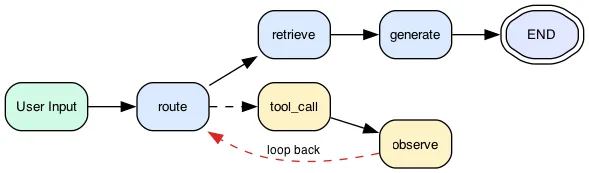
What it is: Graph-based agent orchestration (from the LangChain team, but a separate project). Agents are stateful graphs — nodes are functions, edges define control flow.
Architecture decisions:
State is a typed dictionary that propagates through the graph
Conditional edges enable branching (if/else in agent logic)
Checkpointing at graph nodes (resume from last completed node)
Subgraphs for encapsulation (nest one agent inside another)
Strengths:
Most expressive orchestration model — any agent pattern is representable
Checkpoint-based persistence — survive restarts
Massive ecosystem (thousands of integrations)
Streaming and human-in-the-loop built in
Limitations:
No compute management — "bring your own everything" for infrastructure
Checkpoints lose inter-checkpoint state (crash between checkpoints = lost work)
Graph model has a learning curve — simple ReAct feels over-engineered
No tool sandboxing — tools run in the same process
When to use: Complex agent patterns with branching logic. Your team can handle infrastructure complexity.
CrewAI — 53k stars
What it is: Role-based multi-agent framework. Agents have roles, goals, and backstories. They form "crews" that collaborate.
Crew(
  agents=[Researcher(role="...", goal="..."), Writer(role="...", goal="...")],
  tasks=[research_task, writing_task],
  process=Process.sequential
)
Architecture decisions:
Agents defined by role + goal + backstory (natural language config)
Processes: sequential, hierarchical (manager delegates), or consensual
Tool sharing — agents can share tools or have exclusive access
Delegation — agents can delegate subtasks to each other
Strengths:
Lowest barrier to entry — multi-agent crew in 10 lines
Intuitive mental model (roles = how people think about teams)
Pre-integrated tools (Gmail, Slack, HubSpot)
Limitations:
Shallow abstraction — fine-grained control is hard
No event sourcing, no crash recovery
Not for long-running tasks
When to use: Prototyping. Multi-agent tasks that complete in seconds/minutes.
PydanticAI — 17k stars
What it is: Type-safe agent framework. Structured inputs/outputs guaranteed by validation.
agent = Agent(model, result_type=MyPydanticModel, tools=[...])
result = agent.run_sync("query")  # typed, validated
Architecture decisions:
Pydantic models define both input and output schemas
Dependency injection for tool context (database connections, API clients)
Retry logic with type-driven validation (model retries if output doesn't validate)
Model-agnostic — swap providers without changing agent code
Strengths:
Type safety at definition time
Structured outputs guaranteed by validation
Clean dependency injection for tools
Excellent DX for Pydantic-familiar teams
Limitations:
Single-agent, single-turn focused
No persistence, event log, or crash recovery
No multi-agent coordination
When to use: Individual agent interactions that need reliable structured output. A building block for larger systems.
AgentScope (Alibaba) — 26k stars
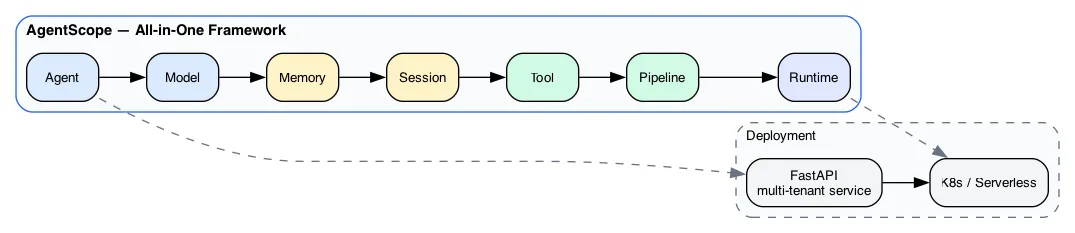
What it is: The most complete all-in-one framework. Orchestration + K8s deployment + observability + sandboxing in one package.
Architecture decisions:
Agent abstraction wraps: model + memory + session + tools
Pipeline orchestration (sequential, parallel, conditional)
MCP + A2A protocol support (interop with external agents)
OpenTelemetry middleware for distributed tracing
Docker/E2B workspace for sandboxed tool execution
Kubernetes deployment with scaling policies
Strengths:
Most "batteries-included" — MCP + A2A + Docker/E2B + OpenTelemetry
Deploy locally, serverless, or on Kubernetes
FastAPI multi-tenant agent service with Web UI
Limitations:
Alibaba ecosystem defaults (DashScope, TableStore)
Large surface area
Not serverless-native (agents are long-running processes)
When to use: You want everything in one package. You need MCP + A2A + K8s + observability without gluing 5 projects.
The Self-Improving Angle
OpenClaw — 378k stars
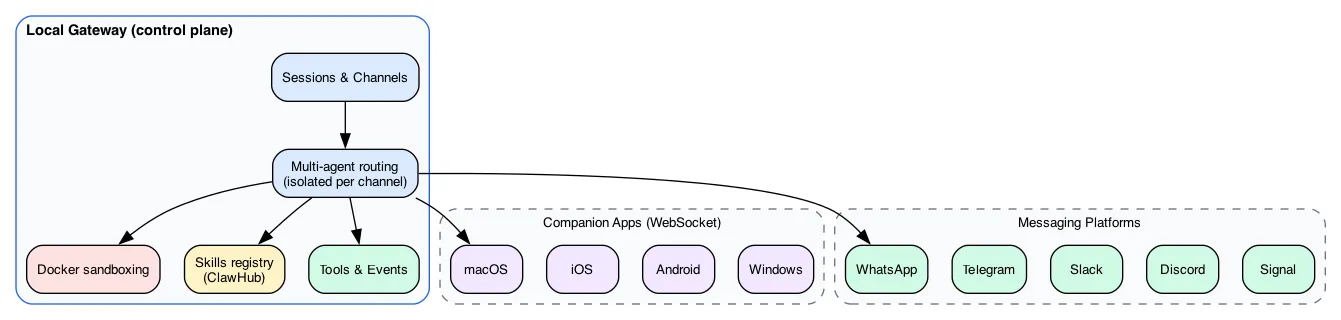
What it is: Local-first personal AI assistant. Runs on your devices, connects to messaging platforms you already use (WhatsApp, Telegram, Slack, Discord, Signal, iMessage). The largest agent project by stars.
Architecture decisions:
Gateway as single control plane (all tools, events, sessions flow through it)
Multi-agent routing — different agents handle different channels/accounts
Skills registry (ClawHub) — community-contributed reusable capabilities
DM pairing for security (unknown senders can't interact without pairing code)
Strengths:
Local-first — runs on your own devices, data stays with you
Multi-platform messaging out of the box (7+ platforms)
Docker-based sandboxing built in
Voice wake/talk mode, Live Canvas visual workspace
Cron jobs, webhooks, skills registry
MIT licensed, backed by OpenAI, GitHub, NVIDIA, Vercel
Limitations:
Personal assistant focus — not designed for enterprise multi-tenant
Node.js/TypeScript only
Local-first means you manage your own infra
Key contribution: Proved that local-first + multi-platform + sandboxing is what users actually want.
Hermes Agent (NousResearch) — 190k stars
Core innovation: agents that learn from experience.

Architecture decisions:
Skill extraction runs in background (doesn't block the agent loop)
Skills are versioned and searchable (agent retrieves relevant skills per task)
Self-improving via Voyager-style skill accumulation
6 terminal backends — same agent code runs locally, Docker, SSH, Modal, Daytona
Why 190k stars: An agent that remembers and grows is fundamentally different from one that starts fresh every session. This is the pattern Voyager (2023) established in research; Hermes brought it to general-purpose agents.
Strengths:
Self-improving loop — autonomously creates and refines skills
Multi-platform messaging (Telegram, Discord, Slack, WhatsApp)
MCP integration
Limitations:
Pre-1.0 (APIs evolving rapidly)
Personal-agent focus — not for enterprise multi-tenant
Self-improvement loop can be opaque
Visual / Low-Code Agent Builders
A massive adjacent category — not traditional frameworks, but how most teams actually start building agents:
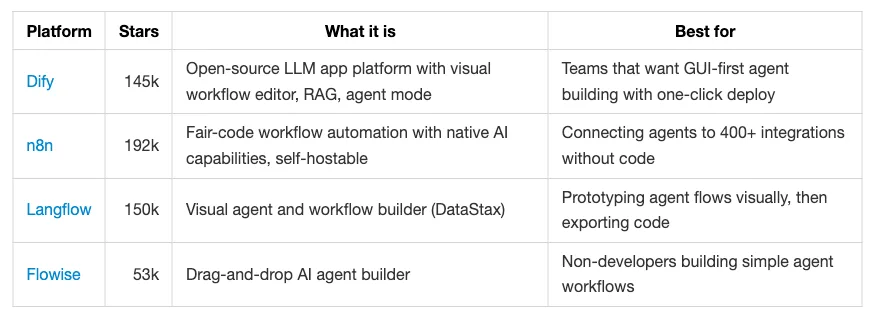
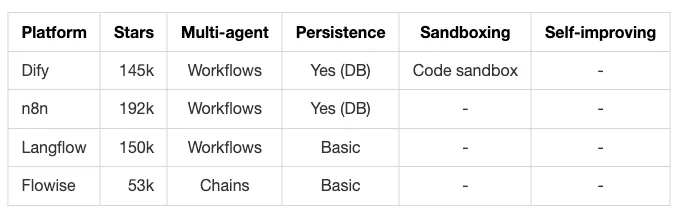
Why include these: They're how most teams prototype before committing to a code-first framework. The visual builders collectively (540k stars) dwarf the code-first frameworks. n8n alone (192k) outweighs LangGraph + CrewAI + PydanticAI + AgentScope combined. The trade-off: speed to prototype vs. flexibility in production.
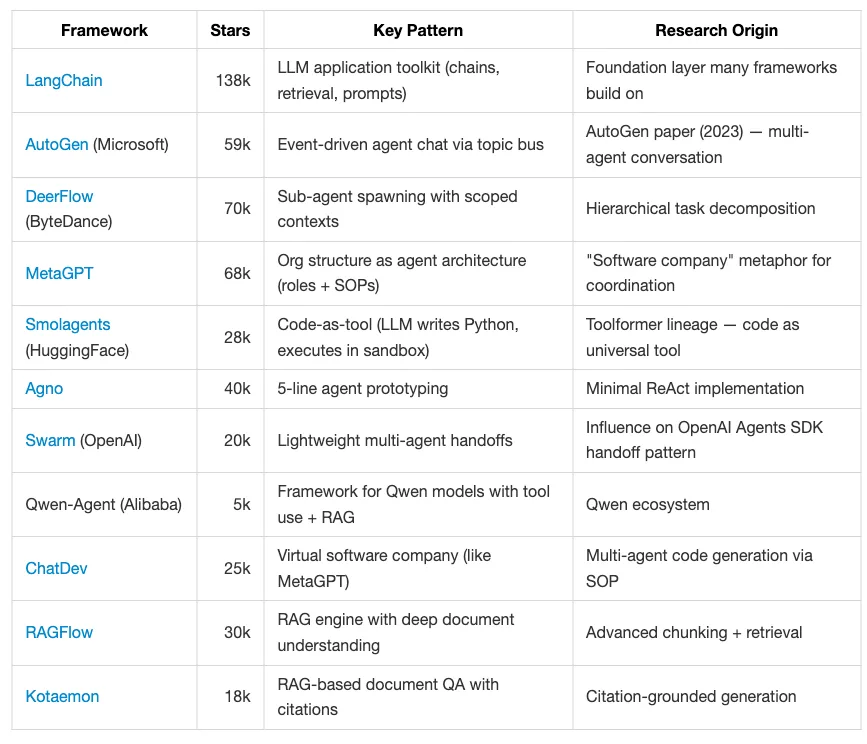
Notable Patterns
Coding Agents: What Production Looks Like
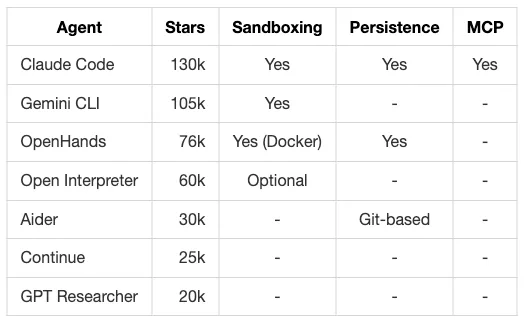
These aren't frameworks — they're finished products showing the target architecture:
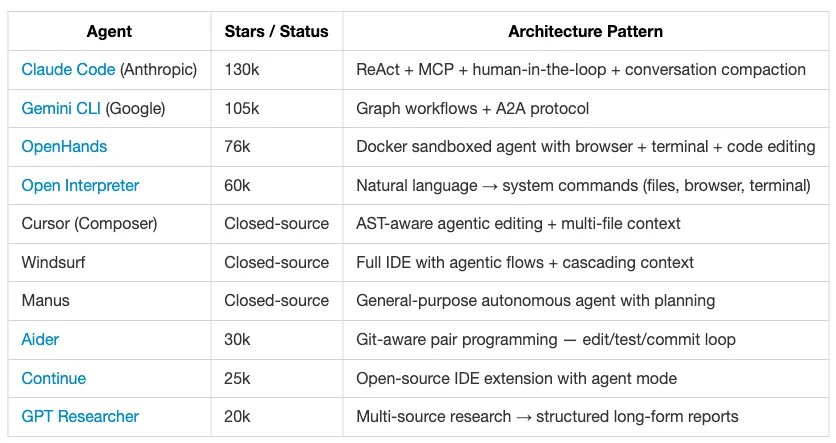
Common production patterns across all:
Streaming intermediate output (user never stares at a spinner)
Human-in-the-loop at destructive/irreversible actions
Context management (compaction, sliding window, relevance filtering)
Sandboxed execution (code runs in containers, not in-process)
Progressive disclosure (show summary, expand on request)
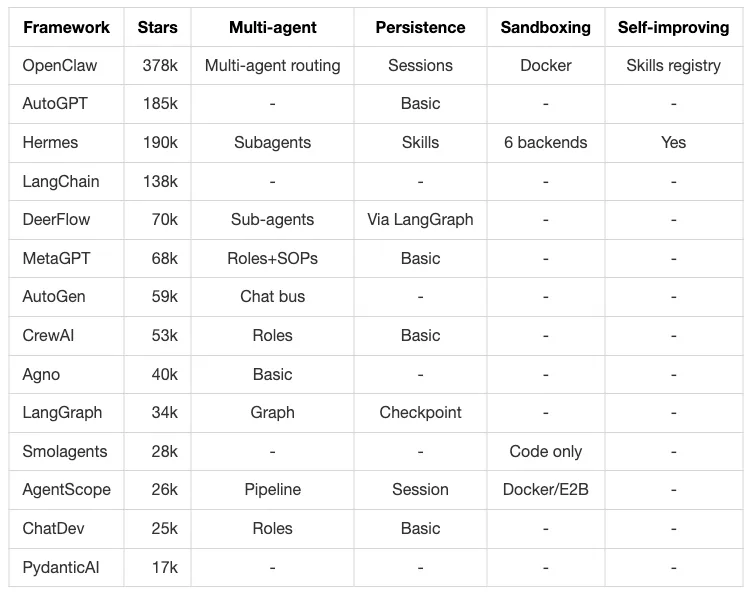
The Full Comparison
Code-First Frameworks
Visual / Low-Code Builders
Coding Agents (Applications)
Key Takeaway
The orchestration layer is the most crowded category — but the real differentiation isn't in the happy-path loop. It's in:
Error recovery: What happens when a tool fails? (Most: crash. LangGraph: conditional edge. AgentScope: retry policy.)
Loop control: How do you prevent infinite reasoning? (Step limits, budget caps, convergence detection.)
Self-improvement: Does the agent get better over time? (Only Hermes and OpenClaw.)
Production infra: How does it deploy, scale, observe? (Only AgentScope ships this.)
The next post examines the second component — what happens when your agent can't survive a restart.