
Agent Landscape #4: Memory — Beyond Context Window Overflow
TL;DR
Agents need three memory tiers: working (in context window), long-term (vector-searchable), and session (per-conversation). Letta (23k) is the most complete — agents explicitly manage their own memory with sleep-time consolidation. Mem0 (58k) is the easiest bolt-on (3 lines of code). Vector DBs are plumbing, not solutions. The key question: should memory be passive (system-managed) or agent-managed (explicit read/write/forget)?
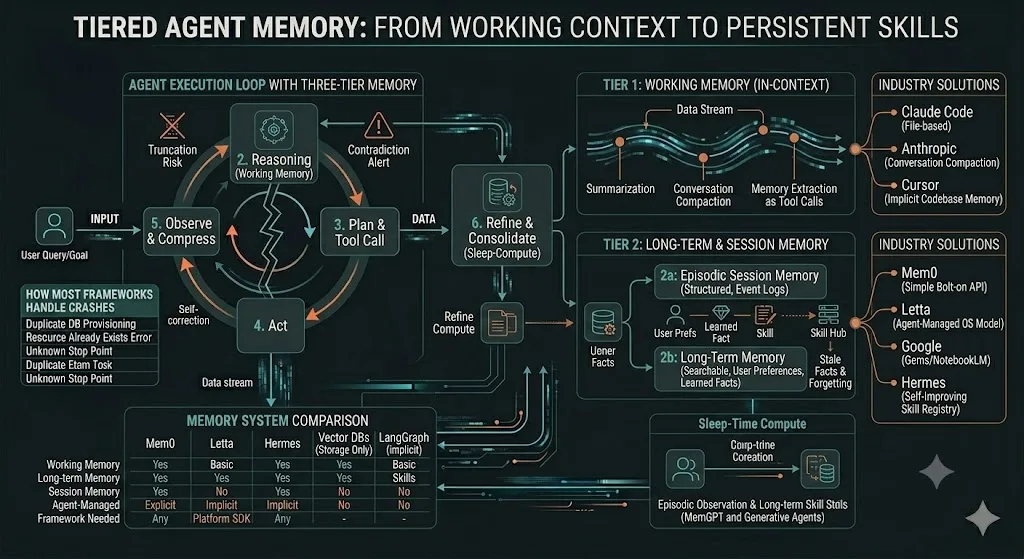
The Problem
You ask your agent to continue yesterday's research. It has no idea what you're talking about.
You've told it three times you prefer TypeScript over Python. It keeps suggesting Python.
It's been working on a complex task for 40 messages. The early context — including why it chose this approach — has been truncated. It contradicts its own earlier decisions.
These are all memory failures, and they happen because:
Context windows are finite. Even 200k tokens fills up after 50 tool calls with results.
There's no persistence between sessions. Close the tab, lose everything.
No retrieval mechanism. Even if facts are stored somewhere, the agent can't find them at the right moment.
No forgetting mechanism. Outdated facts pollute retrieval (your old address, a changed preference).
Three approaches exist. Each solves a different layer of this problem.
Research & Industry Context
Key Papers
MemGPT (Packer et al., 2023, UC Berkeley) — the foundational paper for agent memory. Key insight: treat LLM context like virtual memory — the agent itself manages what's "paged in" and what's "paged out" via explicit memory operations. Directly led to Letta.
Generative Agents (Park et al., 2023, Stanford) — simulated town of 25 agents with memory streams, reflection, and planning. Demonstrated that agents with structured memory (observation → reflection → plan) exhibit emergent social behaviors.
RAG (Lewis et al., 2020) — Retrieval-Augmented Generation. Instead of cramming everything into context, retrieve relevant chunks at query time. The foundation for long-term memory in all agent systems.
Voyager (Wang et al., 2023) — skill library as memory. Instead of remembering raw experiences, extract reusable procedures. This is the pattern Hermes and OpenClaw implement.
Sleep-Time Compute (Letta, 2024) — agents consolidate and reorganize memories during idle periods (between user interactions). Like how human sleep consolidates short-term into long-term memory.
Self-RAG (Asai et al., 2023) — agent decides when to retrieve, what to retrieve, and whether the retrieval is relevant. Adaptive retrieval rather than always-retrieve.
How Industry Solves This
Anthropic (Claude): Projects feature — user-configured persistent instructions and context loaded every session. Plus conversation compaction for within-session memory. Simple, effective, not agent-managed.
OpenAI (ChatGPT Memory): Automatic memory extraction — model identifies facts worth remembering, stores them, retrieves on subsequent conversations. User can view/edit/delete memories. Passive extraction, not agent-managed.
Google (Gemini): Gems — persistent instructions + style. Notebook LM for long-form context. No explicit agent memory system.
Claude Code: File-based memory system — CLAUDE.md files and per-project memory that persists across sessions. Agent reads these at conversation start. Hybrid: some auto-saved, some user-configured.
Cursor/Windsurf: Codebase indexing as implicit memory — the agent "remembers" the full codebase via embeddings and retrieval. Not conversational memory but functional equivalent for coding tasks.
Common production patterns:
Tiered storage (fast in-context + searchable long-term + archival)
Explicit memory operations as tool calls (not passive)
Compression/summarization for old context
User control (view, edit, delete what the agent remembers)
Open Source Solutions
Letta (formerly MemGPT) — 23k stars
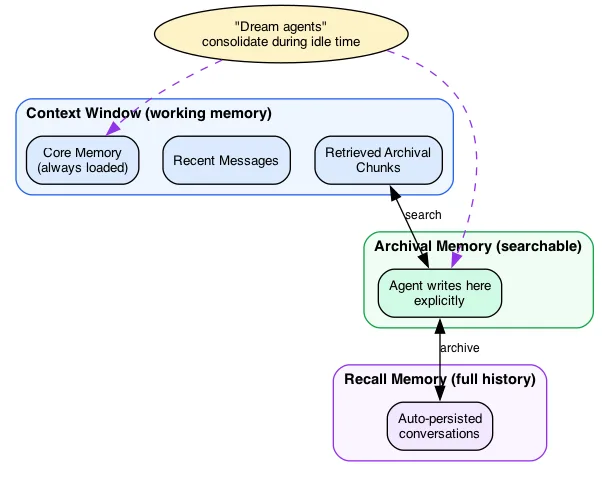
What it is: A memory-first agent platform from UC Berkeley research. Core insight: give agents explicit control over their own memory, like an OS manages virtual memory.
Strengths:
Most sophisticated memory system in any agent framework
Agents explicitly manage their own memory (read, write, search as tool calls)
Sleep-time compute — reorganize memories during idle periods
Portable memory — agents migrate across machines with memory intact
Limitations:
Requires running a Letta server (not serverless)
No container orchestration or tool sandboxing
Memory is the product — everything else is secondary
Key insight: Memory must be a first-class primitive that agents actively manage — not a passive append-only log that overflows.
Mem0 — 58k stars
What it is: A memory layer that bolts onto any existing framework. Simple API: add(), search(), get_all(). Handles embedding, storage, retrieval with automatic deduplication.
from mem0 import Memory
m = Memory()
m.add("User prefers dark mode and concise responses", user_id="u1")
results = m.search("user preferences", user_id="u1")
Strengths:
Easiest integration (3 lines of code to add memory to any agent)
Framework-agnostic (LangChain, CrewAI, custom)
Automatic deduplication and conflict handling
Managed service option (no vector DB ops)
Limitations:
Memory-only — no execution, tools, or sessions
Black-box management (you don't control what gets remembered)
Not designed for session-scoped memory (global per user/agent)
Key insight: The API simplicity is the model to follow. But memory can't be external-only — it needs to integrate into the agent's execution loop.
Vector Databases (Chroma, Qdrant, LanceDB)
Storage engines for embedding vectors. The infrastructure layer for RAG and semantic search.
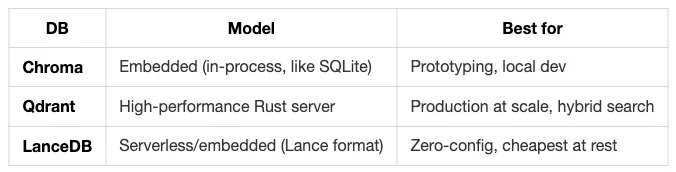
The relationship to agents: These are backends, not solutions. They store vectors and answer similarity queries. They don't know about agents, sessions, or memory lifecycle. An agent memory system uses a vector DB — it isn't one.
The Three-Layer Problem
Production agents need three kinds of memory that no single project fully addresses:
1. Working Memory (in context window)
What the agent is currently doing
Recent conversation turns, active task state
Challenge: Context window is finite. What gets evicted? When?
2. Long-term Memory (searchable, persistent)
User preferences and patterns
Learned facts from past sessions
Skills and procedures discovered over time
Challenge: Retrieval quality. Stale memories. Conflicting facts.
3. Session Memory (per-conversation, structured)
Full conversation history for a given task
Tool call results and intermediate state
Compressed summaries for replay
Challenge: Grows linearly. Compression loses information. When to summarize?
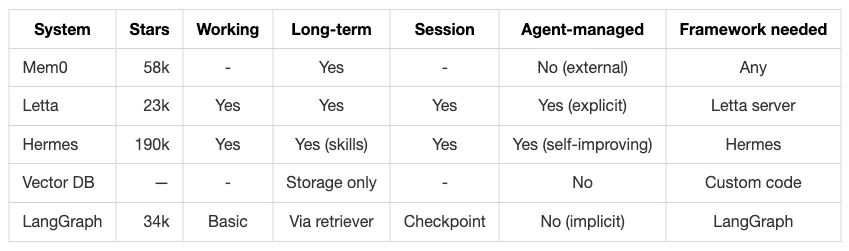
Comparison
Key Takeaway
The memory problem is unsolved because it spans three layers:
What to remember (working memory management)
Where to store it (vector DB, KV store, event log)
When to recall it (retrieval strategy per turn)
Letta is the most complete answer but requires buying into their full platform. Mem0 solves storage/recall but not management. Vector DBs are plumbing, not solutions.
Production agents need a memory interface that supports all three layers, backed by pluggable storage, with agent-controlled read/write/forget operations.