
Agent Memory Deep Dive: How It Works, Why It Breaks, and Where Research Is Headed
TL;DR
Every major AI agent made a different bet on memory — files, vectors, graphs, virtual memory, temporal decay. Each is defensible. None is complete. The deeper question isn't which framework is best, but what *architecture* is needed: should agents accumulate everything and rely on smarter retrieval? Or should they forget like humans do, keeping only what proves useful over time? Research is actively split on this. Here's what exists, why it fails, what the brain suggests, and what remains genuinely unresolved.
The Problem
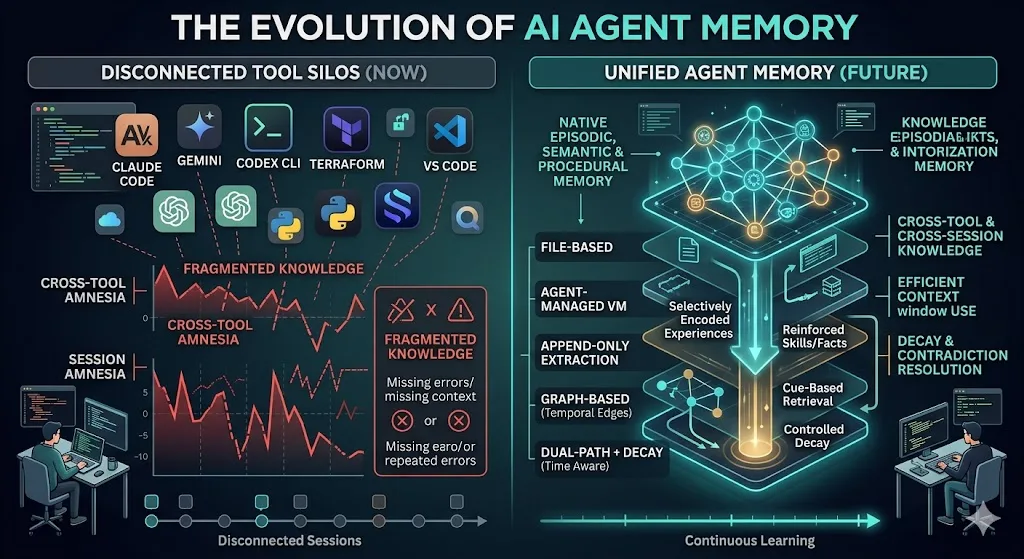
Tuesday morning: you debug a Terraform module with Claude Code. Spend 30 minutes finding the root cause — a provider version incompatibility. Session ends.
Late morning: you ask Gemini to research blue-green deployment patterns for the same infrastructure. It surfaces three approaches you hadn't considered. You pick one.
Afternoon: you open Codex to scaffold the deployment automation. It knows nothing about the Terraform fix from this morning or the deployment pattern you chose in Gemini. You re-explain both from scratch.
Evening: back in Claude Code, new session, same project. It doesn't remember the morning session either. You explain the fix a third time.
Two problems in one day: cross-tool (Claude Code, Gemini, and Codex can't see each other) and cross-session (Claude Code can't see its own earlier session).
5 tools × 3 sessions/day × 250 working days = ~3,750 AI interactions/year. The knowledge created — debugging solutions, architectural decisions, learning progressions — lives in disconnected silos. No unified view. No cross-reference. No way to ask "what have I learned about X across all my tools?"
Five Approaches to Agent Memory
Rather than reviewing individual projects, it's more useful to understand the architectural patterns. Every system maps to one of these:
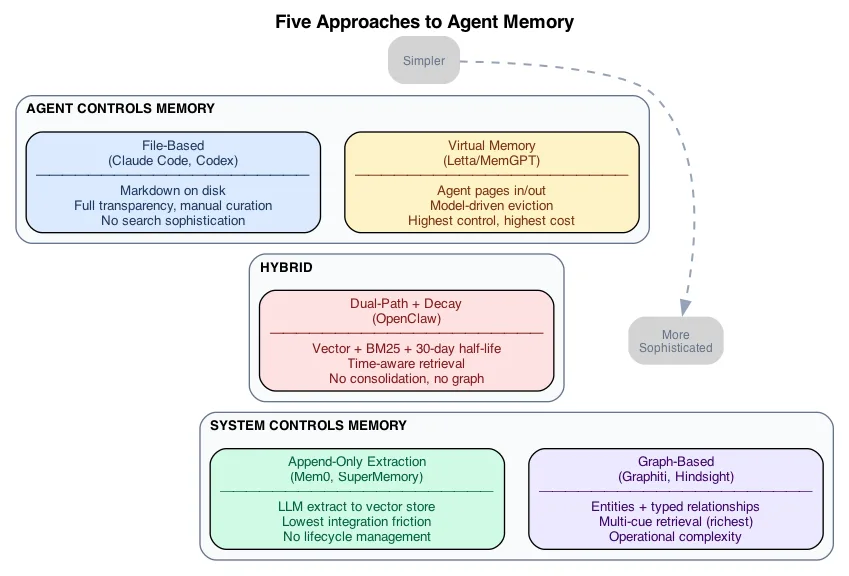
1. File-Based (Claude Code, Codex CLI)
Memory = markdown files on disk, loaded into the system prompt each session. Human-readable, git-controllable, zero dependencies.
Infra analogy: A flat-file database. No indexes, no query planner, linear scan on read. Works at small scale, degrades predictably.
Strength: Transparent, indestructible, user-controlled. Limitation: No search sophistication, no relationships, manual curation as it grows.
2. Agent-Managed Virtual Memory (Letta/MemGPT)
Context window treated as RAM. The agent explicitly pages knowledge in and out using memory tools (core_memory_append, archival_memory_search).
Infra analogy: Virtual memory with model-driven page replacement instead of LRU/LFU.
Strength: Agent has true control over what's in working memory. Limitation: Requires strong models (weak ones waste tokens managing memory). Platform lock-in.
3. Append-Only Extraction (Mem0, SuperMemory)
Conversations → LLM extraction → vector store. Simple API: add(), search(), get_all(). Facts extracted and embedded automatically.
Infra analogy: ETL pipeline with a vector warehouse as sink. Data in, stays forever.
Strength: Lowest integration friction. Framework-agnostic. Limitation: No lifecycle management. Corpus grows unbounded, retrieval degrades over time.
4. Graph-Based (Graphiti/Zep, Cognee, Hindsight)
Memory stored as entities + typed relationships with temporal validity. "User → uses → Fastify [since: 2026-04]." Multi-cue retrieval across vector + keyword + graph walk + time.
Infra analogy: A knowledge graph with a temporal index. Queries traverse structure, not just similarity.
Strength: Richest retrieval. Relationships enable spreading activation. Limitation: Operational complexity (requires graph DB). No native decay.
5. Dual-Path Search with Decay (OpenClaw)
Vector + BM25 keyword search fused with rank weighting. 30-day half-life on memory strength — older entries rank lower unless reinforced by access. Auto-compaction compresses long sessions.
Infra analogy: Dual-index search with configurable TTL. Closest to treating memory as an information retrieval problem.
Strength: Most complete retrieval pipeline in a coding agent. Time-awareness built in. Limitation: Decay is time-only (not access-frequency-weighted). No consolidation, no graph.
Notable Variants
Hermes — "Frozen snapshot" pattern: memory rendered into system prompt once at session start, never mutated mid-session. Exploits LLM prefix caching for performance. Plus a unique "skills" system (procedural memory — learned runbooks that self-improve).
TencentDB Agent Memory — Progressive pyramid (L0 raw → L1 atoms → L2 scenes → L3 persona). The strongest consolidation story — only system with true background distillation.
How These Approaches Compare
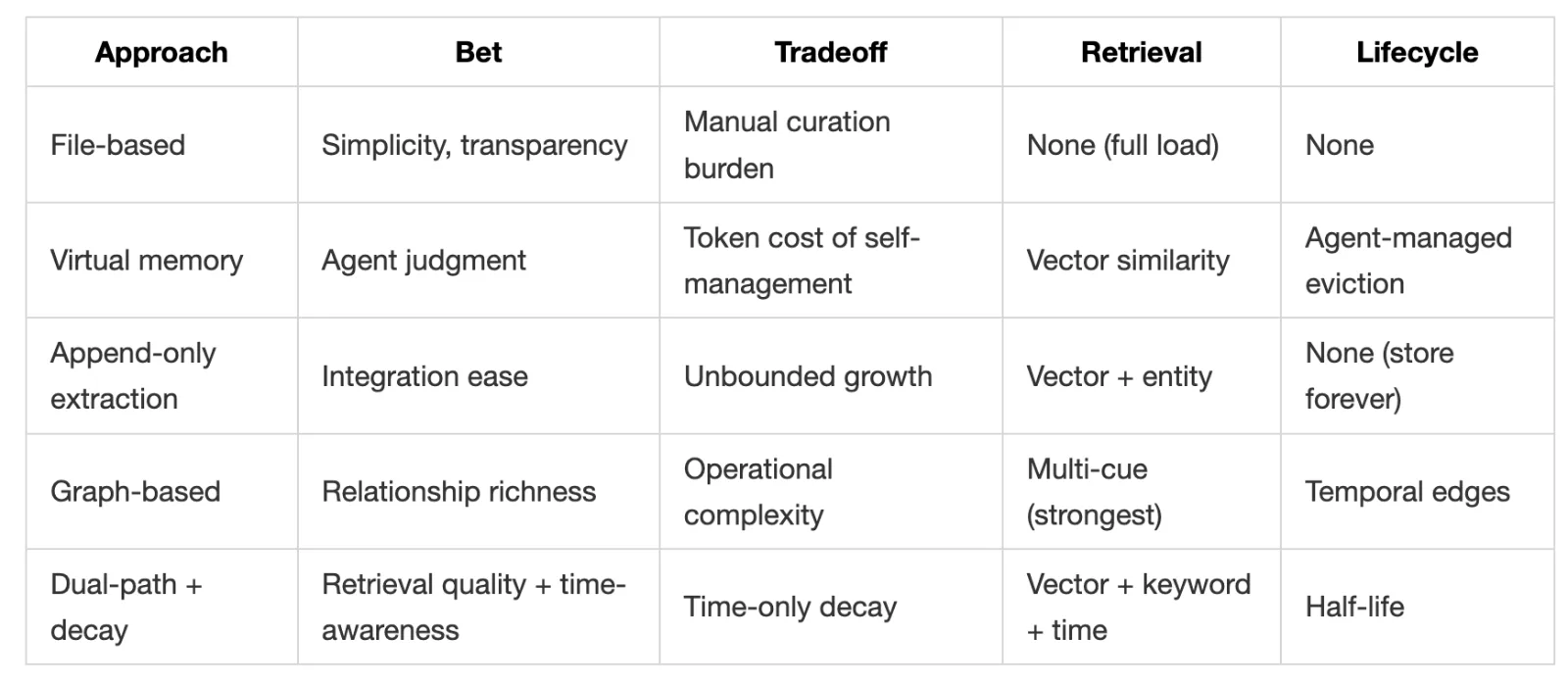
What this reveals: The tradeoff axis isn't "good vs bad" — it's simplicity vs sophistication and agent control vs system control. Every approach optimizes for a real constraint. The gap isn't in what they chose to build, but in what the field collectively hasn't solved regardless of approach.
The 4 Failure Modes
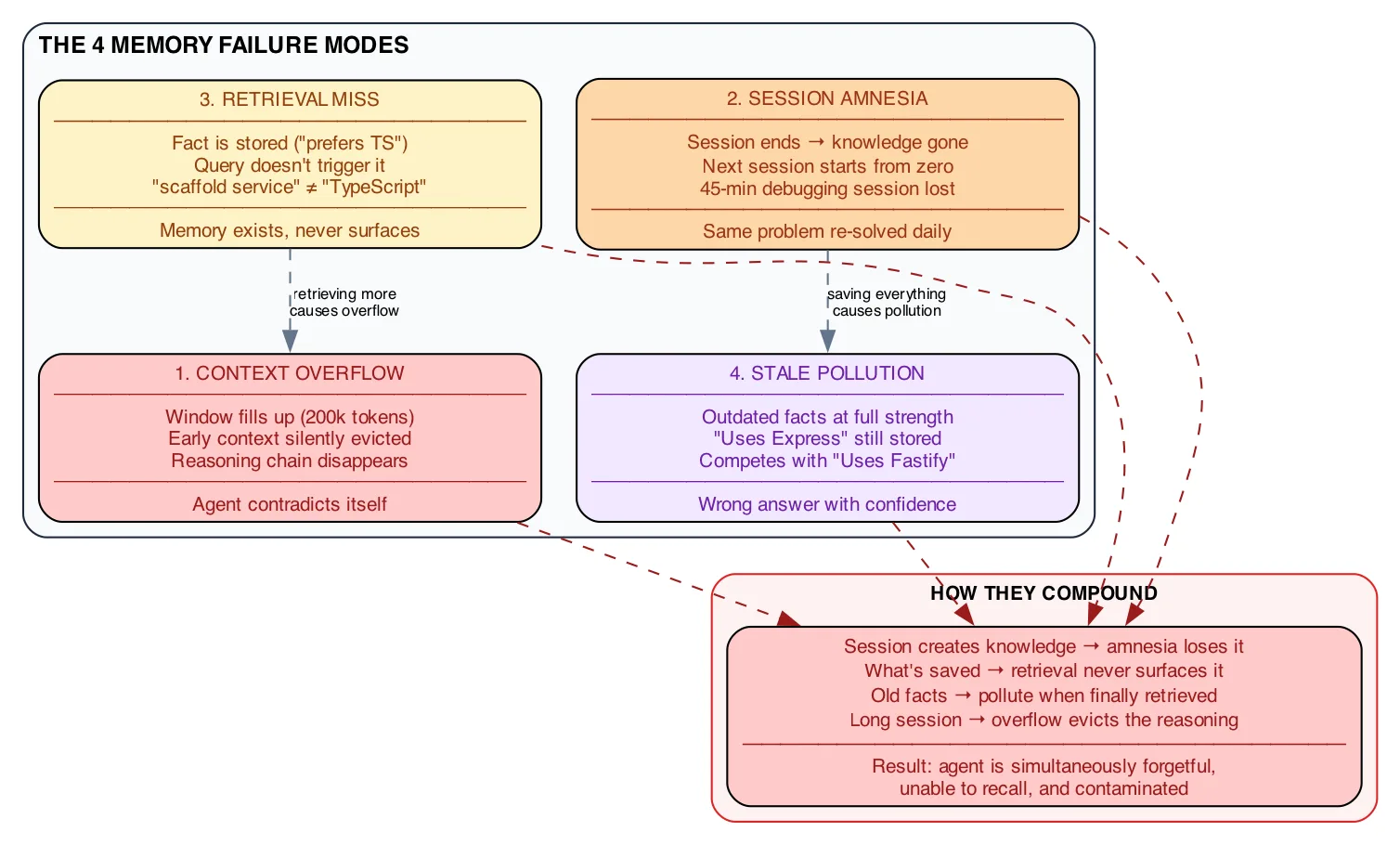
Regardless of which approach you use, memory breaks in four distinct ways:
1. Context Overflow
200k tokens fills fast — 50 tool calls can consume the entire window. When earlier context gets evicted, the agent loses the reasoning behind its decisions. It continues with confidence, now contradicting itself.
What's lost: "I chose A because X rules out B" compresses to "Using A." When X changes, the agent has no basis to reconsider.
2. Session Amnesia
New session = blank slate. A 45-minute debugging session produces root cause, failed approaches (and why they failed), the fix, and side discoveries. None persists. Next similar issue: full diagnostic repeated from scratch.
3. Retrieval Miss
"I prefer TypeScript" is stored. You ask "scaffold a billing microservice." The query has zero semantic overlap with the preference. The memory exists but never fires.
The key insight: Today's retrieval is reactive (matches query terms). The most valuable memories need to be proactive (fire based on situation — a language choice is being made — not query similarity). This is spreading activation from neuroscience, and no production system does it well.
4. Stale Pollution
After months: "Uses Express" (Jan), "Evaluating Fastify" (Mar), "Migrated to Fastify" (Apr), "Trying Hono" (May). Search "what framework?" — all return with equal weight. The agent may confidently use the January answer.
The compounding effect: These aren't independent. Amnesia → re-explanation → overflow. Saving everything → pollution. Retrieving more → noise → overflow. Each naive fix creates another failure.
What Neuroscience Offers (A Lens, Not a Prescription)
The brain provides a model — but whether it maps directly to agents is genuinely debatable. Here's what biology does, and why the translation isn't straightforward.
Three Memory Systems
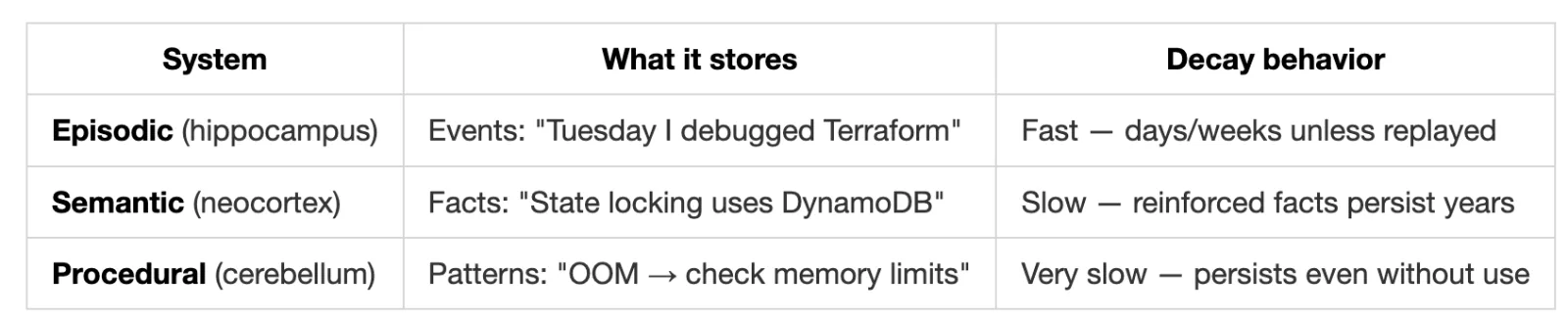
These aren't copies of the same data — they're different representations created through different processing pathways. You experience an event (episodic) → extract a principle (semantic) → internalize a behavior (procedural).
Most agent systems do episodic (raw transcripts) and sometimes semantic (extracted facts). Almost nobody implements procedural (Hermes's "skills" is the exception). The processing between types — how experience becomes knowledge becomes automatic behavior — is where the gap is widest.
Five Biological Properties
Selective Encoding — The brain discards >99% of input. Only what's novel, surprising, or contradictory gets stored. Whether agents should pre-filter (encode selectively) or store everything and filter at retrieval time — this is a design choice without consensus.
Cue-Based Retrieval — Memories activate when multiple signals converge (time + context + content + association), not from single-query similarity. Systems implementing multi-cue retrieval (graph + vector + keyword + time) feel qualitatively better at recall.
Offline Consolidation — During sleep: replay episodes, extract patterns, form durable knowledge. For agents: background workers that distill raw transcripts into structured facts. Not on the hot path. Only TencentDB fully implements this with its L0→L3 pipeline.
Reconsolidation on Recall — Accessing a memory updates it. Strength increases with use, decreases with contradiction. The system self-tunes.
Forgetting — Where the analogy gets contested for agents.
The Research Frontier: Open Debates
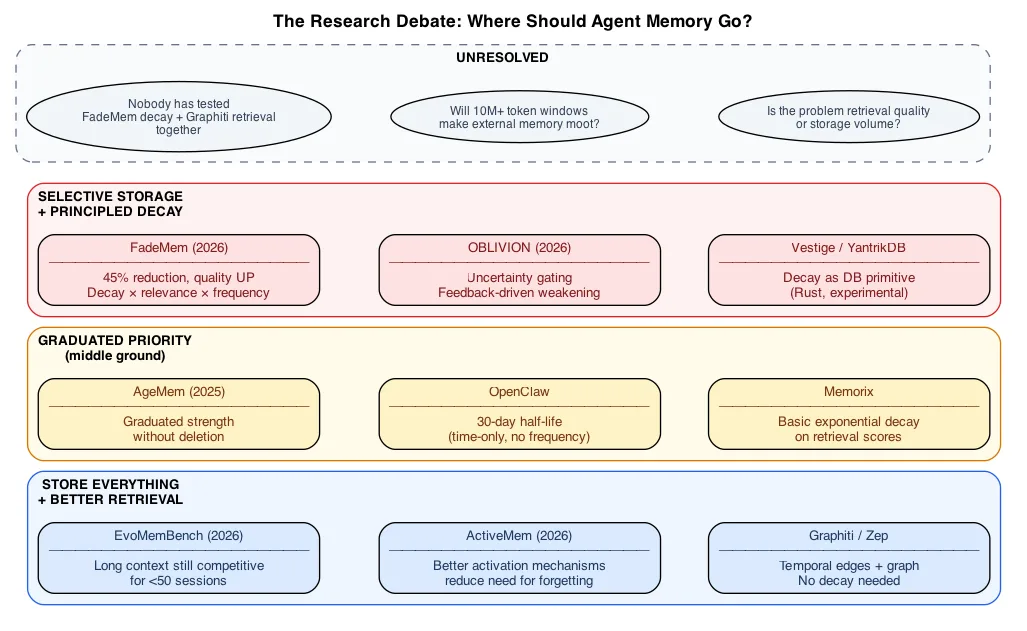
Debate 1: Should Agents Forget?
For forgetting:
FadeMem (Wei et al., 2026): Exponential decay modulated by relevance and access frequency. Result: 45% storage reduction, retrieval precision increased. Their argument: too much noise drowning signal was the real failure mode.
strength(t) = initial × e^(-λt) × relevance_boost × log(1 + access_count)OBLIVION (Rana et al., 2026, NEC Research): Uncertainty-gated reads — before surfacing a memory, estimate confidence. Suppress low-confidence. Explicit negative signal ("that's wrong") weakens entries. Without a weakening mechanism, no path to recover from incorrect memories.
Against forgetting:
EvoMemBench (Wang et al., 2026): Tests 15 methods across evolving-knowledge scenarios. Finding: long-context models still compete for <50 sessions. External memory's advantage only emerges over time (>30 days, frequently-changing facts). If windows keep growing, forgetting might be premature optimization.
The information-loss argument: Storage is free for agents (no metabolic cost like brains). A forgotten memory is permanently lost. If retrieval were perfect, corpus size wouldn't matter — the problem might be in retrieval quality, not storage volume.
The compliance angle: Enterprise settings may require full retention. Graduated retrieval priority is different from information loss.
Current state: The field is genuinely split. Nobody has tested whether combining FadeMem-quality decay with Graphiti-quality retrieval is better than either alone. The experiments compare decay-vs-no-decay with the same retrieval quality, which doesn't resolve the question.
Debate 2: Retrieval-First vs Store-Less
If multi-cue retrieval (graph + vector + keyword + time) were perfect, would corpus size matter?
Graphiti/Hindsight bet no — invest in retrieval sophistication, keep everything.
FadeMem/OBLIVION bet yes — retrieval precision degrades inevitably with scale.
ActiveMem (2026) explores a middle path — better activation mechanisms (proactive context-aware retrieval) that reduce the need for explicit forgetting.
Debate 3: Contradiction Resolution
Independent of forgetting, contradictions must be handled when facts evolve:
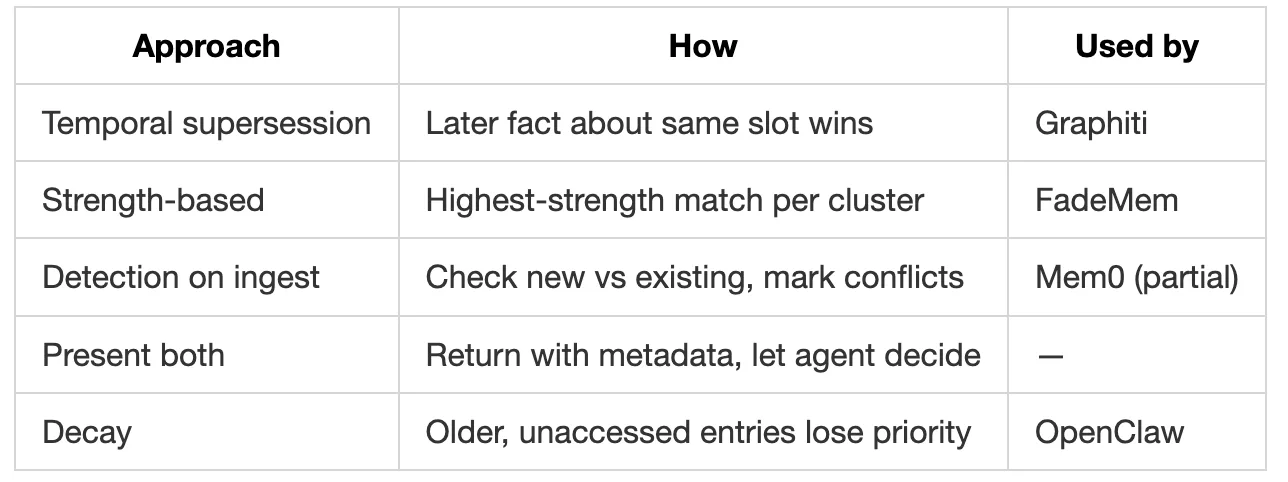
These are independent mechanisms. You can do temporal supersession without forgetting (Graphiti does). You can do decay without supersession (OpenClaw does). The right answer probably varies by fact type.
Debate 4: Where Does Consolidation Belong?
Raw episodes → structured knowledge requires processing. When and how?
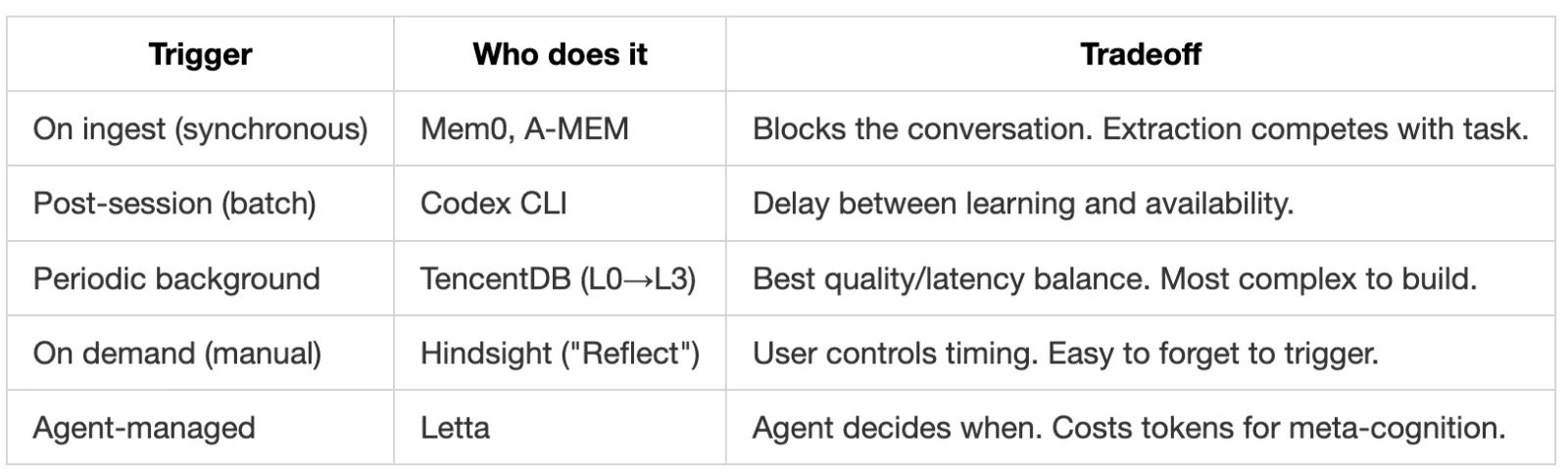
No consensus on best approach. The TencentDB model (periodic background with progressive distillation) is the most neurologically faithful, but also the hardest to implement correctly.
The Structural Gaps (Consensus)
These are problems where the field agrees something is missing:
1. No Cross-Tool Memory
Every tool is an island. No capture standard (each stores differently). No interchange format. No vendor incentive to interoperate (memory lock-in is strategic).
Emerging attempts: Memorix (coding agents via MCP), VESTI (web chatbots via browser), Portable Agent Memory (academic protocol, Merkle-DAG provenance). Nobody bridges both worlds. "Email before SMTP."
2. No Unified Memory Database
Building a complete memory system requires 4-5 separate technologies stitched together (SQLite + vector DB + graph + job scheduler + custom code). What's needed: one binary, one query interface, combining event log + vector + graph + full-text + (optionally) decay.
Experimental engines: YantrikDB, Vestige (FSRS decay), Engram-AI, MuninnDB, DriftDB. All Rust (except MuninnDB/Go). All early. The "SQLite for memory" moment hasn't arrived yet — probably 12-18 months out.
3. The Security Surface
Cross-tool memory creates attack vectors absent in silos. XTHP (NDSS 2026): 75% of memory-enabled tools vulnerable to poisoning — malicious data from one tool redirecting behavior in another.
Any cross-tool solution needs: provenance (which source?), trust scoring (per-source confidence), injection-resistant rehydration.
4. The Pre-Convergence State
We're where databases were in the 1960s — multiple models competing, each working for specific patterns, no unified theory. The relational model won by providing a complete, composable abstraction. Agent memory awaits its equivalent moment.
What's Actionable Today
The pragmatic stack (one SQLite file, two cron jobs):
Episodic: SQLite + sqlite-vec
  - Raw conversations, timestamps, source metadata
  - FTS5 (keyword) + vector column (semantic)

Consolidation: Background cron + LLM (every 6h)
  - Extract facts, link to source episodes (provenance)
  - Dedup, flag contradictions

Semantic: Same DB, separate tables
  - Facts (content, strength, access_count, timestamps)
  - Entities (name, type, aliases)
  - Relations (source, target, type, valid_from, valid_to)

Retrieval: Application code
  - Score = semantic_sim × 0.3 + keyword × 0.2 + entity × 0.2
            + recency × 0.15 + strength × 0.15

Decay (optional): Background cron
  - Hourly: strength *= 0.995 for unaccessed entries
  - On access: strength boosted
  - Below threshold: archive (NOT delete)
Whether you implement decay is a design choice. The first four components alone put you ahead of most production systems.
If you're choosing a system, ask:
"What happens at 10,000 memories?" — reveals whether they've addressed scale
"How do contradictions resolve?" — reveals lifecycle thinking
"Can I export my data?" — reveals portability
If you're using agents today:
Curate Claude Code's memory files actively — treat them like documentation
Track when memory helps vs hurts (correct recall vs confident wrong answers) — the ratio tells you what your actual bottleneck is
Push for transcript export from every tool you use
What Remains Unknown
Does forgetting help or hurt agents? FadeMem says yes empirically. EvoMemBench shows context windows are competitive. Nobody has tested both combined.
Is retrieval the real bottleneck? If multi-cue retrieval were perfect, would corpus size matter? Untested at scale.
Will context windows make this moot? At 10M+ tokens with good attention, does external memory become unnecessary — or does cost alone justify curation?
Can agents manage their own memory well? Letta says yes. Whether model-driven page replacement outperforms system-level management over months of use — no longitudinal study exists.
What's the right consolidation trigger? Time-based? Turn-based? Event-based? Probably depends on use case — but the comparative data doesn't exist.
The field is pre-convergence. The right architecture probably depends on use case, scale, and how much you value auditability vs performance. The honest answer is: we're still figuring it out.
The tools we use daily are getting smarter at reasoning, planning, and coding. But they still can't agree on how to remember — or whether they should.