
Naval's Playbook for Engineers
TL;DR
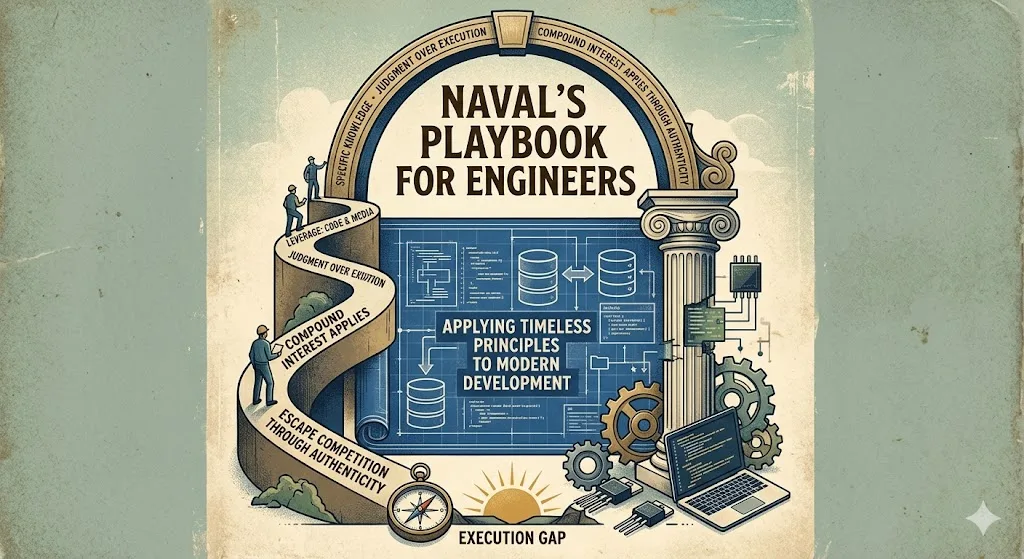
"Escape competition through authenticity. Nobody can compete with you on being you." — Naval Ravikant
Most engineers have heard Naval's ideas. Few have thought about how to actually apply them — day to day, in the terminal, in sprint planning, in career decisions. This is my attempt to bridge that gap: not as personal philosophy, but as practical principles for engineers who want to play a better game.
The Ideas
1. Specific Knowledge
The principle: Specific knowledge is found by pursuing your genuine curiosity. If society can train you for it, it can replace you.
For engineers: "I know React" is trainable. "I understand why this distributed system fails under these specific conditions, and I've built the intuition over five years of on-call" — that's specific knowledge.
How to apply daily:
When you solve a hard bug, don't just close the ticket. Write down why it happened and what structural pattern caused it. That reflection builds irreplaceable intuition.
Choose projects that compound your unique intersection — not the ones that look best on a resume.
If learning something feels like play, lean in. That's the signal.
2. Leverage: Code and Media Are Permissionless
The principle: Three kinds of leverage — labor (people), capital (money), and products with no marginal cost of replication (code, media). Only the third is permissionless.
For engineers: You already have the most powerful form of leverage. Code you write today can serve a million users tomorrow. But most engineers only use this leverage for their employer.
How to apply daily:
Build tools that outlive the sprint. Automation, libraries, internal platforms — these multiply your impact beyond your hours.
Write about what you learn. A blog post, an internal doc, a whisper — media compounds.
Ask yourself: "Am I creating an asset, or am I just trading time?" If the answer is time, find a way to turn that work into something reusable.
3. Judgment Over Execution
The principle: Leverage amplifies judgment. With AI as leverage, the bottleneck shifts entirely from execution speed to decision quality.
For engineers: The question isn't "how fast can I ship this?" It's "should we ship this at all?" The engineer who prevents a bad project is more valuable than the one who finishes it on time.
How to apply daily:
Before coding, spend 30 minutes asking: "Is this the right thing to build? What assumptions am I making?"
In code review, don't just check correctness. Ask: "Does this decision compound well? Will we regret this in six months?"
Set a mental hourly rate. If a task is below your rate and AI can do it — delegate. Spend your time where your judgment matters most.
4. Compound Interest Applies to Everything
The principle: All returns come from compound interest — in wealth, knowledge, relationships, and reputation.
For engineers: Deep expertise in one domain compounds. Jumping to whatever's hot every six months doesn't.
How to apply daily:
Pick a domain and go deep for years, not months. Distributed systems, ML infra, security — whatever genuinely interests you.
Relationships compound. The engineer you help today might bring you into the best opportunity of your career in five years.
Knowledge compounds only if you retain it. Write things down. Teach others. Build on yesterday's understanding.
Avoid "résumé-driven development" — optimizing for breadth over depth resets your compounding clock.
5. Escape Competition Through Authenticity
The principle: The way to escape competition is to be so uniquely yourself that no one can replicate your combination.
For engineers: Most engineers compete on the same axes — language proficiency, framework knowledge, system design interview patterns. The ones who break out combine skills in unusual ways.
How to apply daily:
What problems are you uniquely positioned to see and solve? That's your edge.
Don't copy another engineer's career path. The optimal path for you is one that doesn't exist yet.
"What would I build if I didn't care what the market thinks?" — that question often leads to the most valuable work.
6. Learn to Sell
The principle: Learn to sell. Learn to build. If you can do both, you will be unstoppable.
For engineers: Most engineers only learn to build. They assume good work speaks for itself. It doesn't.
How to apply daily:
Write clear design docs that persuade, not just inform.
In meetings, frame technical decisions in business impact. "This reduces latency by 200ms" means nothing to leadership. "This increases conversion by 3%" does.
Your PRs, your commit messages, your Slack explanations — these are all sales. You're selling clarity, trust, and competence every day.
7. Read the Originals, Not the Summaries
The principle: Read the original texts. Foundational books don't expire.
For engineers: Don't learn distributed systems from Medium articles. Read the Dynamo paper. Read the Raft paper. Read Designing Data-Intensive Applications cover to cover.
How to apply daily:
When you encounter a technology, find the original paper or RFC. The summary lost the nuance you need.
One hour with a primary source is worth five hours with blog posts about that source.
Build a reading habit around fundamentals: operating systems, networking, databases, algorithms. These don't deprecate.
The Execution Gap
Here's the honest truth: none of this is secret. Naval said it publicly. Thousands of engineers have read it, nodded, and changed nothing.
The gap isn't knowledge. It's execution. It's the daily decision at 2pm when you could either:
(a) knock out three more JIRA tickets, or
(b) spend an hour writing down what you learned this week and publishing it
It's choosing (b) often enough that it compounds.
It's choosing depth over breadth when breadth feels safer. It's choosing to say "we shouldn't build this" when everyone else is already coding. It's choosing to write the design doc that persuades, not just the one that documents.
The playbook is simple. The execution is hard. But that's exactly why it works — most people won't do it.
Start with one. Pick the principle that resonates most. Apply it for 30 days. Then add another. Compounding starts slow, but it starts.
Appendix: Naval's Core Ideas (Complete Reference)
Wealth Creation
Seek wealth, not money or status. Wealth is assets that earn while you sleep. Money is how we transfer time and wealth. Status is your rank in a social hierarchy.
You're not going to get rich renting out your time. You must own equity — a piece of a business — to gain financial freedom.
The Internet has massively broadened the possible space of careers. Most people haven't figured this out yet.
Play iterated games. All returns in life — whether in wealth, relationships, or knowledge — come from compound interest.
Specific Knowledge
Specific knowledge is knowledge you cannot be trained for. If society can train you, it can train someone else and replace you.
Specific knowledge is found by pursuing your genuine curiosity and passion rather than whatever is hot right now.
Building specific knowledge will feel like play to you but look like work to others.
Specific knowledge is often highly technical or creative. It cannot be outsourced or automated.
Leverage
Three forms of leverage:
Labor — people working for you (oldest, least efficient)
Capital — money working for you (requires someone else's permission)
Products with no marginal cost of replication — code and media (permissionless, most democratic)
Code and media are the new leverage. They're permissionless — you don't need anyone's approval to write code or publish content.
An army of robots is freely available — it's just packed in data centers. Use it.
Judgment
Leverage is a force multiplier for your judgment. With leverage, bad judgment gets amplified just as much as good judgment.
Judgment requires experience but can be built faster by learning foundational mental models.
Demonstrated judgment — with accountability and a clear track record — is how you attract capital and labor.
Building & Selling
Learn to sell. Learn to build. If you can do both, you will be unstoppable.
Set an aspirational hourly rate for yourself. If fixing something costs less than your rate, outsource it. This forces you up the value ladder.
Work as hard as you can, but on the right thing. The direction matters more than the intensity.
Decision-Making
Easy choices, hard life. Hard choices, easy life.
If you can't decide, the answer is no. When facing two equally difficult options, pick the one with more short-term pain (it usually has more long-term gain).
Escape competition through authenticity. Nobody can compete with you on being you.
Read what you love until you love to read. Apply this to learning anything.
Happiness & Philosophy
Happiness is the absence of desire. It's learned by being present, not by achieving more.
Desire is a contract you make with yourself to be unhappy until you get what you want.
A calm mind, a fit body, a house full of love. These cannot be bought. They must be earned.
The most important skill is the ability to be alone with your thoughts without being anxious or bored.
Retirement is when you stop sacrificing today for an imaginary tomorrow. You can retire at any age by doing what you'd do regardless of money.
On Learning
The means of learning are abundant — the desire to learn is scarce.
Read the original texts, not the summaries. Foundational books (math, science, philosophy) don't expire.
There's no skill called "business." Avoid business magazines and classes. Study microeconomics, game theory, psychology, persuasion, ethics, math, and computers.
If you're reading it on the front page, it's too late. Seek knowledge where others aren't looking.